The one behind my Creative Inspiration
Salvador Dalí
Spanish, 1904–1989


Salvador Dalí. Gelatin silver
Gift of James Thrall Soby. © 2016 Man Ray Trust/Artists Rights Society (ARS), New York/ADAGP, Paris
Salvador Dalí belongs to the Surrealism movement, but he was also connected to Cubism and Modern Art. His artwork evolved over time, beginning with Impressionist paintings and later developing into surrealist and classical works. Dalí worked with many forms of art, including oil paintings, watercolors, drawings, sculptures, films, photography, jewelry, and performance pieces. Another famous artist during this time was Pablo Picasso, who was also associated with Cubism. Dalí was born on May 11, 1904, in Figueres, Spain. He attended the San Fernando Academy of Fine Arts in Madrid and later held his first one-man show in Paris, where he joined the Surrealist movement. However, he was eventually expelled from the group in 1934 after conflicts with its members. As Dalí moved away from Surrealism and entered his classical period, he created a series of large canvases focused on scientific, historical, and religious themes. In 1974, he opened the Teatro Museo in Figueres, Spain, followed by major retrospectives in Paris and London later in the decade.
Gallery

The Persistence of Memory 1931
24.1 x.33 cm
Oil on Canvashttps://www.moma.org/collection/works/79018?sov_referrer=theme&theme_id=5140

The Little Theater 1934
Salvador Dali
32.3 x 42.5 x 31.1 cm
Wood and glass, painted
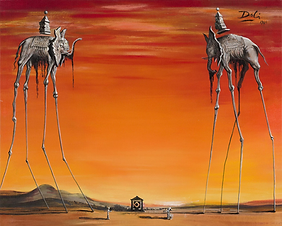
The Elephants , 1948
Salvador Dali
49 x 60 cm
Oil on Canvas
Ship with Butterfly , 1937
Salvador Dali
20 x 24
Oil on canvas

Illumined Pleasures 1929
Salvador Dali
23.8 x 34.7 cm
Oil and collage on board

My Salvador Dali inspired Artwork
2026
Jacob Arias
Colored Pencils
© 2026 Jacob Arias. All rights reserved.